
Few proteins in the body have attracted more attention from aging researchers than sirtuins, often called the body's longevity proteins.
They are a family of seven proteins, each with a distinct role in cellular maintenance, and all of them share one critical dependency: NAD+. As NAD+ levels decline with age, sirtuin activity follows, and with it, many of the processes that keep cells functioning well.
Nuchido TIME+ is a clinically studied NAD+ supplement formulated to support NAD+ production and the sirtuin activity that depends on it.

What Are Sirtuins?
Sirtuins are a family of proteins found in virtually every cell in the body. Their primary function is regulatory: they monitor the cellular environment and adjust gene expression, repair activity, and metabolic output in response to what they detect. In this sense, they act as a kind of cellular quality control system, responding to stress, damage, and energy availability.
Humans have seven different sirtuins, SIRT1 through SIRT7, each with their own specific role in supporting cellular health. What they all share, however, is a dependence on NAD+ to function
- SIRT1: found in the nucleus; regulates gene expression, DNA repair, and the cellular stress response. The most studied sirtuin in the context of aging and metabolic health
- SIRT2: located in the cytoplasm; involved in cell division and metabolic regulation
- SIRT3: mitochondrial; regulates energy metabolism and protects against oxidative stress
- SIRT4: mitochondrial; involved in fatty acid metabolism and insulin regulation
- SIRT5: mitochondrial; regulates detoxification pathways and energy production
- SIRT6: nuclear; involved in DNA repair, inflammation regulation, and metabolic control
- SIRT7: found in the cell nucleus; regulates ribosomal function and stress responses

Why Sirtuins Need NAD+ to Function
Every sirtuin requires NAD+ to carry out its work. It is not simply that NAD+ helps sirtuins function more efficiently. NAD+ is the fuel they run on. Without it, they cannot function. This is why maintaining healthy NAD+ levels is so central to sirtuin activity, and by extension, to so many of the cellular processes that support how we age.
This direct dependency means sirtuin activity is tightly linked to cellular NAD+ availability. When NAD+ is abundant, sirtuins are active. As NAD+ levels fall, sirtuin activity falls with them, not because the proteins are damaged, but simply because the resource they run on is no longer available in sufficient supply.
This is a critical point for understanding aging. The gradual decline in NAD+ levels that occurs from the mid-20's onwards does not just affect energy production. It reduces the activity of the entire sirtuin family simultaneously, which directly impacts every aspect of cellular health.
The Connection Between SIRT1 and Biological Age
- Of the seven sirtuins, SIRT1 has received the most research attention in the context of aging. It operates in the cell nucleus and plays a central role in regulating the genes and repair processes that influence how cells age at a molecular level.
- Research has shown that SIRT1 activity declines with age in parallel with falling NAD+ levels. This is not a coincidence. SIRT1 activity is directly dependent on NAD+ availability, and as NAD+ falls, SIRT1 becomes progressively less active. Studies examining the relationship between SIRT1 and biological age have found associations between SIRT1 expression and markers of cellular aging including telomere length.
- SIRT1 also plays a role in regulating mitochondrial biogenesis through its activation of PGC-1α a protein that stimulates the production of new mitochondria. When SIRT1 activity is reduced, mitochondrial renewal slows, contributing to the decline in cellular energy capacity that accompanies aging.
- Additionally, SIRT1 plays a role in regulating inflammatory pathways, including the suppression of NF-kB, a key driver of chronic inflammation. As NAD+ levels decline with age, SIRT1 activity weakens, which contributes to the persistent, low-grade inflammation that researchers increasingly link to age related disease and decline.
- With increasing age, NAD+ levels and sirtuin activity steadily decrease, further compounded by sedentary behavior and metabolic stress.
- See also how this connects to age-related decline in cellular energy and biological age.
How Restoring NAD+ Supports Sirtuin Activity
- Because sirtuin activity is governed by NAD+ availability, restoring NAD+ levels provides the substrate sirtuins need to become more active again. NAD+ is central to longevity science precisely because of this: it powers a regulatory system that influences how cells maintain themselves over time.
- Most of the NAD+ inside your cells is produced via the NAMPT pathway (salvage pathway), making it the central hub for keeping sirtuins fuelled and functional. This is the same salvage pathway that Nuchido TIME+ is designed to support. By activating NAMPT, Nuchido TIME+ helps restore the NAD+ supply that sirtuins depend on, supporting SIRT1-mediated DNA repair and gene regulation, SIRT3-mediated mitochondrial function, and the broader cellular maintenance that the sirtuin family coordinates.
- Nuchido TIME+ is the only NAD+ supplement clinically proven in a human trial to restore the body's natural NAD+ production pathway. In doing so, our clinical research also showed increases in cellular NAD+ and SIRT1 activity. View our clinical evidence.
What Supports Sirtuin Activity
Maintaining NAD+ Levels
Since sirtuin activity is directly governed by NAD+ availability, boosting your NAD+ levels is the most direct way to support the sirtuin system. This means addressing both the decline in NAD+ production through the salvage pathway and the increase in NAD+ consumption that occurs with age. Our NAD+ supplements page explores the options in more detail.
Exercise
Physical activity stimulates NAMPT expression and supports NAD+ production, which in turn supports sirtuin activity. Regular movement is one of the most well-evidenced ways to maintain the cellular environment in which sirtuins function effectively.
Polyphenols
Certain plant compounds including quercetin, resveratrol, and EGCG have been studied for their ability to support sirtuin activity. Nuchido TIME+ includes quercetin and EGCG as part of its whole-system formulation, selected both for their sirtuin-supporting properties and their role in reducing the inflammatory NAD+ consumption that limits sirtuin function with age.
The Times+
Read our blogs to understand the science behind sirtuins, NAD+ decline, and what supports healthy cellular aging.

The Role of NAD+ in Feeling Energized, Healthy and Balanced
Learn why NAD+ is so important for keeping the body healthy, balanced and energized.
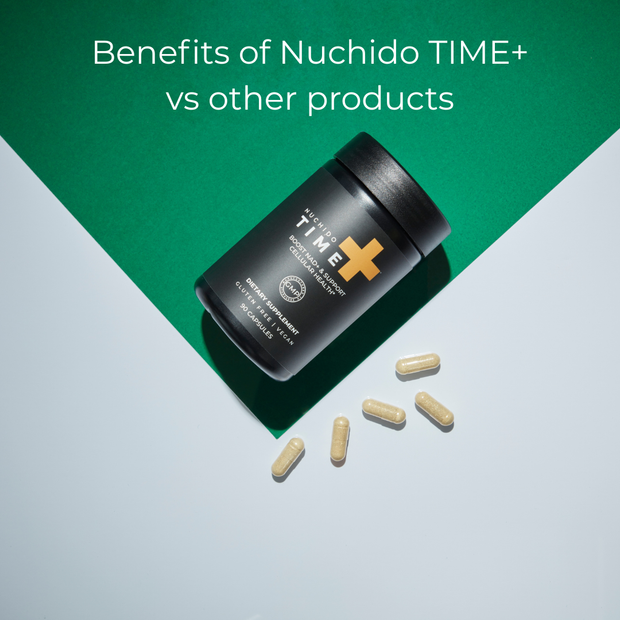
Benefits Of Nuchido TIME+ Vs Other Products
Nuchido explains how Nuchido TIME+ is different to NMN, NR and NAD+ IVs and injections. Read the guide to learn how not all supplements are created equally.
NAD+: Performance at the cellular level
Discover how NAD+ can support your training goals by boosting energy, powering muscle repair, and regulating inflammation.
FAQs
Most of us can benefit from increased NAD+ levels and some groups of people will benefit even more from a NAD+ supplement: