Does NAD+ Decline With Age? What the Latest Research Actually Shows.
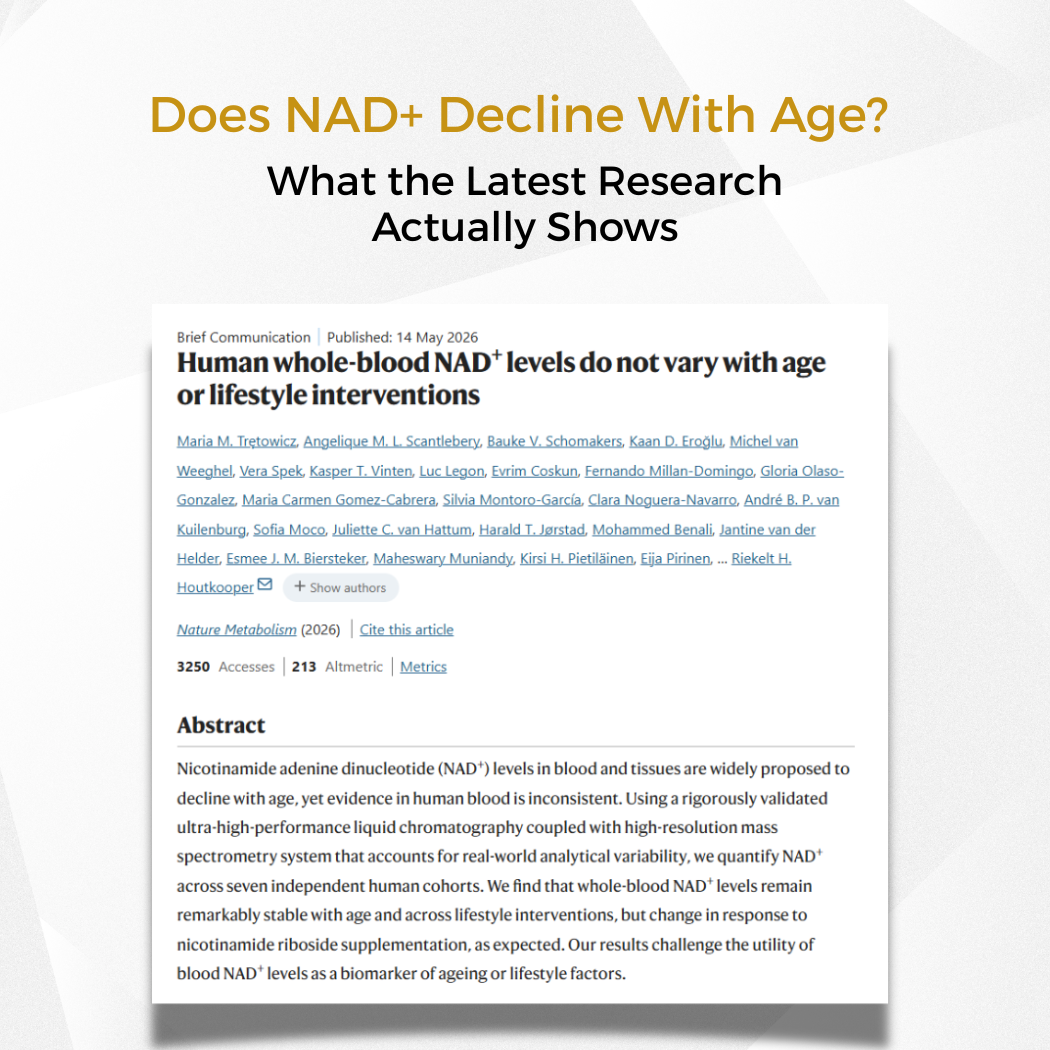
A paper just published in Nature Metabolism is generating a lot of attention, and with it, some headlines that are doing more harm than good.
"Scientists show that NAD+ does not decline with age." "New study shows NAD+ supplements do not work."
We want to address this directly, because this is a really good example of how scientific studies get misinterpreted, and how those misinterpretations can leave people more confused than informed. So let's look at what this study actually measured, and what we can meaningfully take from it.
Summary
A new Nature Metabolism paper is circulating with misleading headlines. Here is what the science actually shows:
- The study found that whole-blood NAD+ is an unreliable biomarker of aging, not that NAD+ does not decline with age
- NAD+ works inside our cells, not in our blood, making blood an inherently poor measure of NAD+ biology
- Age-related NAD+ decline in tissues such as muscle, skin and brain has been consistently documented across two decades of research
- At-home NAD+ blood testing kits face sample stability problems that make results unreliable
- The science of NAD+ and healthy aging is not in question. How we measure it is simply becoming more precise
What Did the New NAD+ Study Actually Measure?
The researchers, based at Amsterdam UMC with collaborators across Europe, developed a highly precise method to measure NAD+ in whole blood. What they found was that whole-blood NAD+ is a very noisy and unreliable marker.
NAD+ is naturally unstable outside the body, and it is extremely sensitive to how a sample is collected, stored and processed. Even small differences in handling, such as how quickly a sample is frozen or how many times it is thawed and re-frozen, produce large variations in the measured NAD+ level. Once they accounted for this variability, the researchers could not detect meaningful age-related changes in blood NAD+ across their study participants.
Their conclusion was clear: whole blood should not be used as a biomarker of aging.
That is a very different statement from "NAD+ does not decline with age."
Why Blood Is Not a Reliable Measure of NAD+ Biology
This is where the misinterpretation happens, and it is an important distinction to understand. NAD+ is an intracellular molecule. That means it does its work inside our cells, not in our blood. Inside our cells sit the mitochondria that power energy production and the DNA that depends on NAD+ for repair.
We know that everything to do with aging starts inside our cells. In our skin cells, our muscle fibers, our brain and our liver, the age-related decline in NAD+ has been well documented in exactly these tissues over more than two decades of research.
Multiple independent research groups across the world have consistently shown that NAD+ levels in metabolically active tissues fall as we get older. This is not a disputed area of science. In fact, the authors of this new paper have published that evidence themselves. Their new paper does not contradict that work. It refines something separate: the reliability of blood as a measurement tool.
Saying "blood is a poor proxy for NAD+ biology" is not the same as saying "NAD+ biology is unchanged with age." One is a statement about measurement. The other is a statement about the underlying science.
What This Study Confirms About NAD+ Blood Tests and Home Testing Kits
This paper speaks directly to two positions we have held publicly at Nuchido for a long time.
The first is the problem with at-home NAD+ blood testing kits. We are asked regularly to recommend one, and while they have become increasingly popular in wellness clinics and longevity spaces, we have consistently cautioned against them. The reason is simple: NAD+ degrades rapidly once blood leaves the body. By the time a fingerprick sample has been collected, sealed, posted and processed by a laboratory, the NAD+ in that sample will have broken down significantly. The result you receive is not a reliable reflection of your NAD+ biology. This new paper confirms that our caution was well-founded.
The second is that blood NAD+ level is not the most meaningful measure of what is happening in your cells. We have always argued that if you want to understand NAD+ biology, you need to look at what is happening intracellularly, inside the cells of the tissues that actually matter. A single blood reading, taken at one point in time, tells you very little about the health of your cellular NAD+ system. That is why in our clinical trials we did not just measure NAD+ levels, but also measured levels of intracellular enzymes such as NAMPT, which powers NAD+ production, to show how Nuchido TIME+ works to boost NAD+ levels.
What does this NAD+ study actually tell us
The science of NAD+ and healthy aging is not in question. Two decades of research point to the same conclusion: NAD+ biology changes with age in ways that matter for how our cells function, and supporting that biology is a meaningful target for healthy aging.
What this new paper adds is an important refinement to how we measure it. Whole blood is a noisy, unreliable window into your NAD+ biology, and at-home blood testing kits face fundamental stability challenges that make their results difficult to interpret. The NAD+ space moves fast, and not everything that gets amplified on social media reflects where the actual science stands.
FAQS
Does NAD+ decline with age?
Yes. Two decades of tissue research consistently show that NAD+ levels fall in metabolically active tissues such as muscle, skin and brain as we get older. This is not disputed in the scientific literature. Read our blog to learn more about the causes of NAD+ decline with age.
What did the new Nature Metabolism NAD+ study actually find?
It found that whole-blood NAD+ is a noisy, unreliable biomarker of aging, largely because NAD+ is unstable outside the body and highly sensitive to how samples are handled. The study does not contradict the evidence for age-related NAD+ decline in tissues.
Are at-home NAD+ blood tests reliable?
The evidence suggests not. NAD+ degrades rapidly once blood leaves the body, meaning results from fingerprick postal tests are unlikely to accurately reflect your cellular NAD+ status.
How does Nuchido TIME+ support NAD+ levels?
Rather than simply providing NAD+ precursors, Nuchido TIME+ is designed to support NAMPT, the key enzyme in the body's own NAD+ recycling system, helping cells regenerate NAD+ more efficiently from within. Learn more about how Nuchido TIME+ works.
References:
- Trętowicz, M. M., Scantlebery, A. M., Schomakers, B. V., Eroğlu, K. D., van Weeghel, M., Spek, V., ... & Houtkooper, R. H. (2026). Human whole-blood NAD+ levels do not vary with age or lifestyle interventions. Nature Metabolism, 1-9
- Janssens, G. E., Grevendonk, L., Perez, R. Z., Schomakers, B. V., de Vogel-van den Bosch, J., Geurts, J. M., ... & Hoeks, J. (2022). Healthy aging and muscle function are positively associated with NAD+ abundance in humans. Nature Aging, 2(3), 254-26
- Henderson, J. D., Quigley, S. N., Chachra, S. S., Conlon, N., & Ford, D. (2024). The use of a systems approach to increase NAD+ in human participants. npj Aging, 10(1), 7.