Why NAD+ declines with age: The Science Explained
We talk a lot about the importance of NAD+ and why it is so valuable to maintain your NAD+ levels as you age for maintaining your active and healthy lifestyle. But to truly appreciate how Nuchido TIME+ works and how this is different to other NAD+ supplements, we must understand what happens to our NAD+ levels as we age and why they decline, because just like everything in biology it is a complex topic.
Research has shown that NAD+ levels decline progressively as we get older, but the reasons behind this decline are complex. Multiple biological processes influence how NAD+ is produced, consumed and recycled within our cells.
In this article, we explore why NAD+ declines with age, the key cellular mechanisms involved, and why understanding these processes is important when considering ways to support healthy NAD+ levels.
Our NAD+ levels half every 20 years
Research has shown that our NAD+ levels decline by around 50% every 20 years, which is alarming as we know NAD+ is vital to maintaining cellular health.
NAD+ is a vital coenzyme and is involved in over 500 chemical reactions within our cells particularly those for energy production, cellular repair and activation of longevity-associated proteins such as sirtuins.
As NAD+ levels fall, these cellular processes can become less efficient, which is why NAD+ decline is increasingly recognised as an important feature of the aging process.
These changes can eventually begin to affect how our cells function. If you're interested in learning more about how this may present in everyday health, you can read about the early signs your NAD levels may be low.
So, what causes this progressive NAD+ decline as we age…?
NAD+ production declines with age
NAD+ cannot enter into the cell directly from the bloodstream. Instead, it has to be manufactured inside the cell from precursors. This means we cannot just absorb NAD+ directly from the nutrients in our food.
In young cells, NAD+ is continuously produced and recycled through various metabolic pathways. One of the most important is the NAD+ Salvage Pathway, which recycles nicotinamide (NAM) back into fresh NAD+.
The salvage pathway acts like a cellular recycling system for NAD+. When NAD+ is used by enzymes such as sirtuins, PARPs or CD38, it is broken down into NAM. Instead of being wasted, this NAM can be converted back into NAD+ through a series of steps. First, the enzyme NAMPT converts nicotinamide into nicotinamide mononucleotide (NMN). NMN is then converted back into NAD+ by NMNAT enzymes.
This recycling process is responsible for generating the majority of NAD+ in our cells and is essential for maintaining healthy NAD+ levels over time. The enzyme which powers the salvage pathway is called NAMPT (nicotinamide phosphoribosyltransferase).
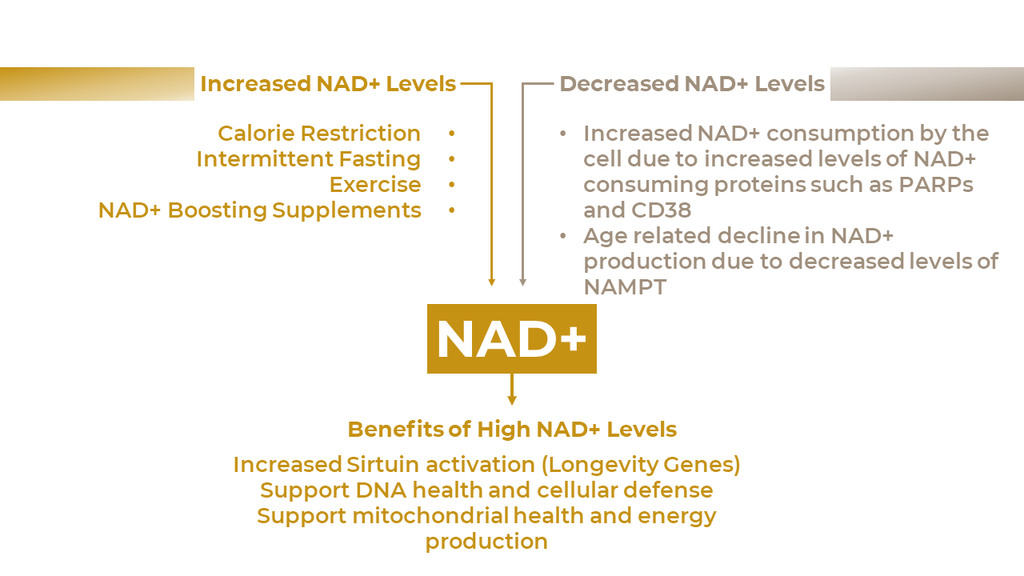
Research has shown that NAMPT levels decline as we age, which significantly reduces the cell’s ability to recycle NAD+. As NAMPT activity decreases, the salvage pathway becomes less efficient and NAD+ levels begin to fall.
That is why part of the Nuchido TIME+ formulation is dedicated to increasing levels of the NAMPT enzyme and enhancing the recycling capabilities of the cell.
NAD+ consumption increases with age
In addition to the decreased production of NAD+, there is also an increased demand for NAD+ within the cell as we age. NAD+ is used by many different proteins within the cell to power essential chemical reactions, and some of these proteins become more active with age and therefore consume more NAD+.
Two of the major NAD+ consumers are PARP enzymes and CD38.
PARP enzymes are involved in maintaining healthy DNA by supporting DNA repair processes, so ensuring they get enough NAD+ is vital. As DNA damage accumulates with age, PARP activity can increase, which in turn leads to greater NAD+ consumption.
CD38 has been extensively studied and is now understood to be one of the largest NAD+ consumer in human cells. Importantly, CD38 levels increase greatly in older cells due to increased levels of chronic inflammation, meaning it wastes a huge amount of the already limited NAD+.
The increased NAD+ consumption in turn generates more waste nicotinamide (NAM). However, older cells have a reduced ability to recycle this nicotinamide back into fresh NAD+ though the salvage pathway.
The result is accumulation of NAM which must be methylated and excreted from the cell, potentially leading to depletion of important methyl donors.
Nuchido TIME+ also contains ingredients designed to inhibit excessive CD38 and support the recycling of nicotinamide through the salvage pathway support, helping cells maintain healthier NAD+ levels.
If you'd like to learn more about how NAD+ decline affects the body, you can read about the early signs that your NAD levels may be low.
Increased Demand and Decreased Supply
Collectively, this increased demand and decreased supply leaves the various cellular pathways fighting over a dwindling supply of NAD+, precisely at the time when cells require it most. As we can see NAD+ biology and its subsequent decline with age is a complex subject involving multiple pathways that affect how NAD+ is produced, consumed and recycled within the cell.
NAD+ decline isn’t just a result of a single factor. Instead, it results from a combination of reduced NAD+ production, enhanced NAD+ consumption and decreased recycling efficiency. Any strategy designed to support healthy NAD+ levels must therefore take this biological complexity into account.
If you’d like to explore some of the ways researchers are studying how to support NAD+ levels, you can read our guide on how to boost your NAD levels.

That is exactly what Nuchido TIME+ does. The formulation is designed to support several of the key mechanisms involved in NAD+ decline by:
-
Increasing the activity of the salvage pathway to improve NAD+ recycling
-
Supporting the enzyme NAMPT, which is essential for NAD+ regeneration
-
Inhibiting CD38, an enzyme that breaks down NAD+, helping to reduce NAD+ depletion and preserve cellular NAD+ levels
We have completed a double-blinded, placebo-controlled crossover study on our next generation NAD+ boosting supplement, Nuchido TIME+. The results demonstrated:
-
Nuchido TIME+ significantly increases cellular NAD+ after only 7 days
-
Unlike NR or NMN it works by switching back on youthful cellular NAD+ production by reactivating NAMPT, a key enzyme in the Salvage Pathway
-
A reversal of biological age by 1.26 years after 28 days of supplementation
-
An increase in the longevity protein SIRT1, a downstream target of NAD+
-
A reduction of inflammatory cytokines indicating that NAD+ is being directed towards beneficial processes rather than inflammatory CD38
-
A reduction in biomarkers of glycation
