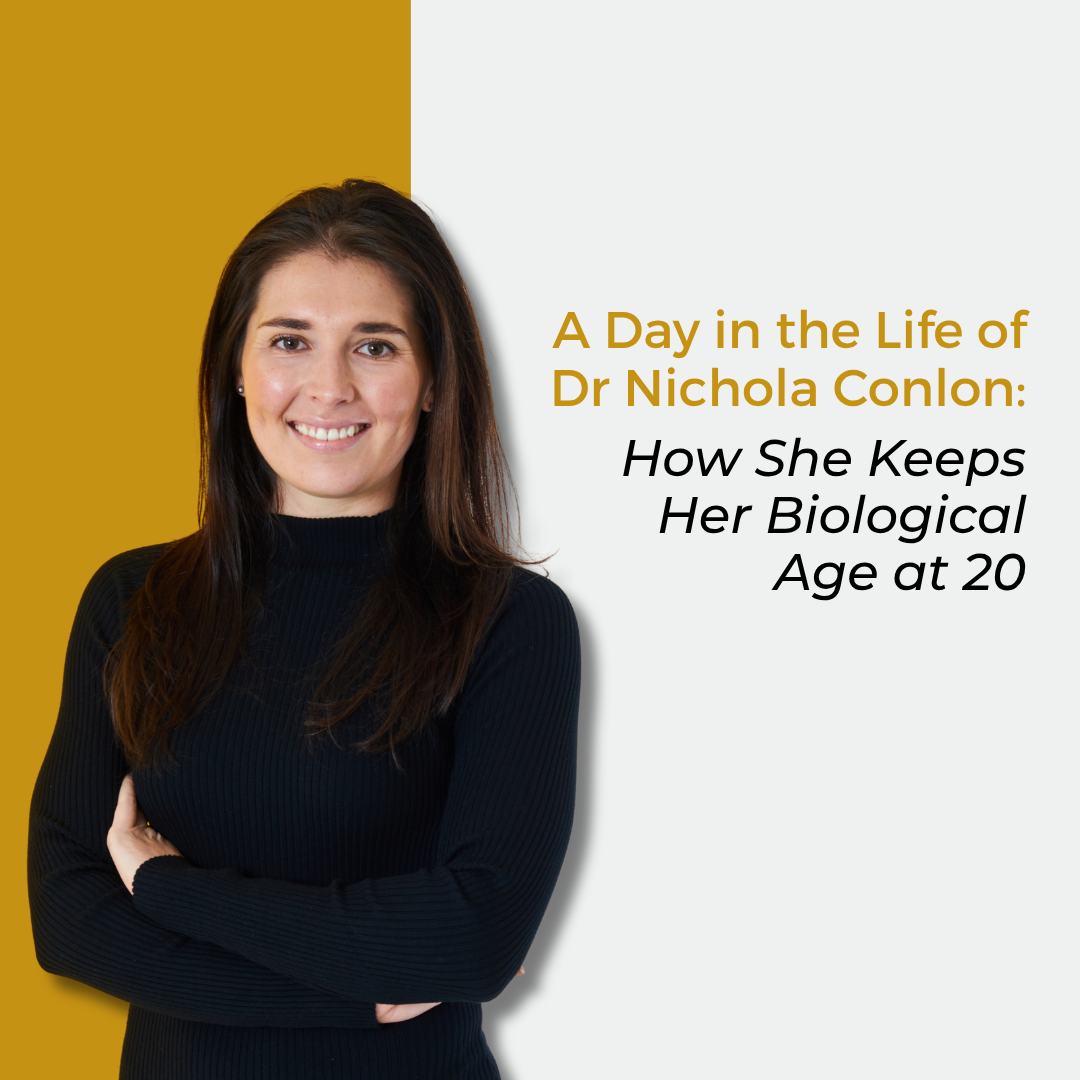
A Day in the Life of Dr Nichola Conlon: How She Keeps Her Biological Age at 20
This blog is a little different from our usual content. We sat down with our CEO, Dr Nichola Conlon, and asked her the question everyone wants answered: how does she keep her biological age at 20? Nichola is 39 years old chronologically, but her biological age, measured via GlycanAge, is 20.
You might expect her routine to be rigid, full of expensive technology and extreme treatments. It is not, as she is quick to tell us.
"You might be surprised that I'm not doing anything completely crazy. There's no magic formula. There's no perfect routine. But if you do the basics consistently, it does pay off."
That is the real theme of this piece. Longevity does not have to be complicated. It has to be consistent. Here is Nichola’s routine, in her own words.
What does your morning routine look like?
One of my non-negotiables has nothing to do with supplements or biohacking gadgets. It is simply getting outside first thing in the morning. It's not about the sunshine, it's about the light.
When light enters your eyes in the morning, it sends a signal to your brain that the day has started. This helps regulate your circadian rhythm, your internal body clock, which influences hormones, metabolism and sleep quality later that night. Living in the UK, that light is not always the bright, inspiring kind. Often it's grey and overcast, but the biology behind it doesn't depend on blue skies.
Circadian alignment plays a foundational role in overall health. It helps coordinate the timing of thousands of genes across a 24 hour cycle, so that simple step outside sets the tone for everything that follows.
How often do you exercise?
I usually pair my morning light with movement, a short walk most days, alongside strength and cardio training around four times a week at the gym. But honestly, that everyday movement is just as important to me as the gym. Walking, getting steps in, moving regularly, especially when I'm travelling and away from the gym, all supports my cardiovascular health, metabolic function and keeps my body in a more naturally active state.
It mirrors what we see in Blue Zone populations, regions where people consistently live longer, healthier lives. It's less about intense exercise and more about consistent movement woven throughout the day.
Do you follow a specific diet?
Not a strict one, no. I work with a few guiding principles instead, and the first is a gentle overnight fast. I tend to leave at least 12 hours between my last meal of the day and my first meal of the next day. This gives the body a break from constant digestion, and during that window, cellular processes like autophagy, the body's natural recycling system for clearing out damaged cellular material, are able to switch on.
Beyond that, I focus on eating a variety of whole foods and try to limit ultra-processed foods where I can. I aim for 30 different plants a week. Research suggests that this kind of dietary diversity supports a more diverse gut microbiome, which has been linked to brain health, inflammation and skin health. I'll be honest, I am certainly not perfect. I absolutely have a sweet tooth but broadly, I aim for that 80/20 balance.
How important is sleep to you?
Of everything I do, this is the one that matters most. Sleep is probably the most powerful tool we have.
I keep a consistent sleep and wake time, aiming for 7 to 8 hours a night, and I track my sleep with an Oura ring so I know what disrupts it. For me, that's come down to two things: a bedroom that runs too warm, which is why I keep my radiator switched off, and alcohol, which I now keep to occasional treats rather than a regular habit.
Do you use things like red light, sauna or cold exposure?
When natural daylight is harder to come by, particularly in winter, I'll sometimes sit in front of a red light panel. Red and near infrared light interact with the mitochondria, the energy producing structures within our cells, which can help support cellular energy production.
I'm also a big fan of sauna, there's a growing body of evidence linking heat exposure to healthy aging outcomes, and I'll take an occasional ice bath, usually a couple of times a week. The dopamine hit you get from it really boosts my mood, and it's also a good way to stimulate the production of mitochondria for energy production.
Do you get your bloodwork done regularly?
Yes, around every six months. And it's not because I'm expecting something to be wrong, it's because I want to understand what's normal for me.
I keep my panel broad: vitamins, minerals, liver function, blood counts, hormones, iron, thyroid, B vitamins, glucose and inflammation markers. Once you understand your own baseline, any future shifts, in energy, mood or how you feel day to day, give you something meaningful to compare against. If you know your optimal levels, you can work to keep them there.
How do you manage stress with such a busy life?
If anyone looked at my life on paper, they'd probably say it's quite stressful. A demanding job, frequent travel, a daughter, a packed schedule. I don't manage stress by removing it completely, because that's not realistic. I manage it by how I respond to it.
It's not short bursts of stress that seem to accelerate biological aging, it's chronic, unrelenting stress, the kind that quietly builds when life gets busy and stays elevated over time. Whenever I find things are getting too much, for me the antidote is nature. I get outdoors, go for a walk, get fresh air.
What supplements do you take?
This is the question I get asked second most often, and my honest answer is yes, I do take supplements, but what I take is personalised to me and probably won't be applicable to you, because it's based on my own blood tests and genetics, which have highlighted certain deficiencies I have in things like folate. I also take functional mushrooms like reishi for immune function and lion's mane for brain health.
That said, there are a few things I think are broadly worth considering for most people, including omega-3, vitamin D and K2, which support several markers linked to healthy aging and are common deficiencies.
Then there's NAD+, something I've researched for many years as a scientist. NAD is a molecule that declines with age and is essential for cellular energy and repair. It's a coenzyme found in every cell in the body, and levels are understood to decline as we get older.
That's what led me to develop Nuchido TIME+, designed to support the body's own natural NAD+ production rather than supply it directly. It's not about filling your cells with artificial NAD+, it's about helping you make your own the same way you did when you were young. And as I created it, I have been taking Nuchido TIME+ longer than anyone else.
So what's the real takeaway?
None of this involves an extreme protocol or a long list of expensive interventions. It's morning light, regular movement, whole food, protected sleep, understanding my own baseline, managing stress through everyday moments in nature, and a small number of considered supplements.
There's no magic formula. There's no perfect routine. But if you do the basics consistently, it does pay off.
That's, in many ways, the whole philosophy behind Nuchido. Longevity science does not need to be overwhelming to be effective. The evidence suggests that it's the fundamentals, done consistently over time, that make the biggest difference to how we age.