What the World's Largest Gut Microbiome Study Actually Found (And What To Do With It)
What Was the American Gut Project Trying to Find Out?
Your gut is home to trillions of bacteria, collectively known as your gut microbiome. In fact, your gut contains almost as many bacterial cells as your body has human cells, and this bacterial community produces compounds that influence digestion, brain health, immune function, skin health and more. For a long time, though, most of what we knew about the gut microbiome came from small studies of a few hundred people at most, which made it hard to know what "typical" gut diversity even looks like.
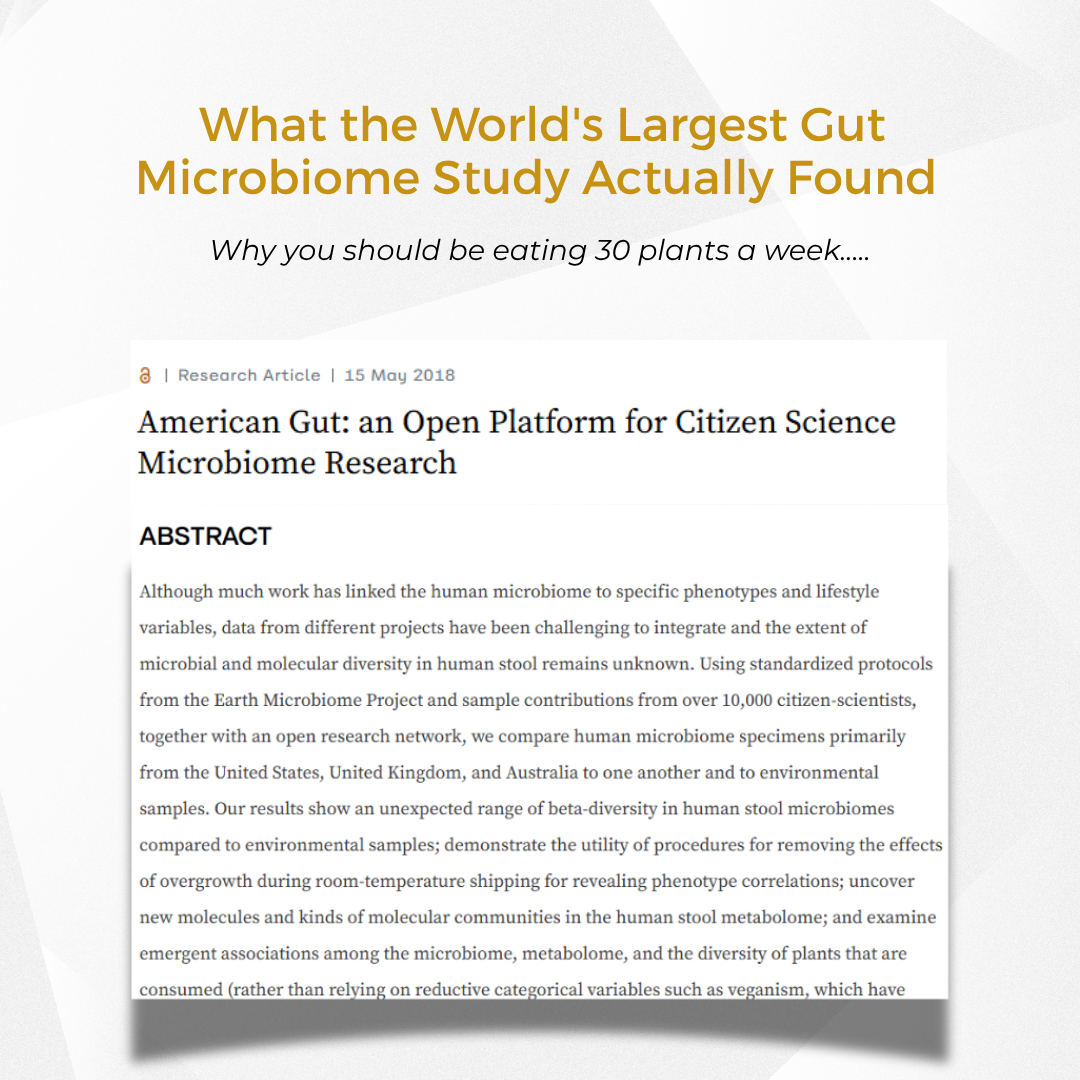
The American Gut Project, published in 2018, set out to change that. Researchers from UC San Diego and a global network of collaborators wanted to build the largest public reference database of the human gut microbiome ever assembled, and to understand what really drives differences between one person's gut and another's.
How Does Gut Health Affect Your Biological Age?
Gut health is closely tied to your biological age, the pace at which your cells are aging on the inside. A more diverse gut microbiome supports a stronger gut lining, meaning lower levels of chronic inflammation across the body and a lower biological age. We've covered this connection in more detail in our blog on How Your Gut Health Impacts Your Biological Age. The American Gut Project findings below add further weight to that picture, showing just how much diet-driven diversity can shape the gut.
How Did They Study Over 10,000 People's Gut Bacteria?
This wasn't a traditional clinical trial. It was citizen science: over 10,000 volunteers from the US, UK, Australia, and 42 other countries mailed in their own stool samples, alongside detailed surveys on diet, health history, and lifestyle. Each sample underwent gut bacteria DNA sequencing, and a subset also had their stool chemically analyzed to look at the actual molecules being produced by their gut bacteria.
The team then compared this enormous, real-world dataset to smaller, more tightly controlled studies, to see whether findings from the clinic held up in the messier context of everyday life.
What Did the Study Actually Find?
A few results stood out.
-
Your gut microbiome is as unique as a fingerprint. The study found that the differences between two people's gut microbiomes can be as large as the differences between two entirely different environments. This is partly explained by genuinely different life circumstances: the researchers found a significant difference in gut bacteria diversity between US and UK participants, and industrialized populations differed even more sharply from those following more traditional, non-industrialized lifestyles. In other words, no two guts, and no two lives, look quite the same.
Plant variety mattered more than diet labels. - People who ate more than 30 different types of plants a week had noticeably more diverse gut bacteria than those eating fewer than 10, including more of certain bacteria that produce short-chain fatty acids, a byproduct linked to gut lining health. Interestingly, broad diet categories like "vegan" or "omnivore" didn't predict microbiome differences nearly as well as plant variety did.
- Individual change can be dramatic. One participant's gut microbiome was tracked before and after major bowel surgery, and the shift in their bacterial makeup was, remarkably, on a similar scale to comparing two entirely different ecosystems.
- People tend to return to their own baseline. Even a year apart, a person's gut samples still resembled their earlier samples more than they resembled anyone else's, suggesting your microbiome has something like a personal signature.
Why Does This Matter for You?
The plant diversity finding is probably the most practically useful. It suggests it's not just whether you eat plants, but how many different kinds, that shapes your gut bacteria. A person eating the same five vegetables every week may be getting less microbial benefit than someone eating a smaller total amount but a wider range.
How Can You Put This Into Practice?
You don't need a complicated plan to apply this. A few practical starting points:
- Aim to add variety rather than volume. Swap in a new vegetable, grain, legume, herb, or fruit each week rather than eating the same rotation, and try to include as many different colorful plants as you can.
- Count plant types, not just plant portions. Different beans, different leafy greens, and different herbs and spices all count separately.
- Use frozen and tinned produce to widen variety affordably, since fresh isn't required for diversity to count.
- Build meals around a base of grains or legumes, then layer in as many different plant ingredients as you reasonably can.
The evidence suggests that variety, not perfection, is what your gut bacteria seem to respond to. Every meal is a chance to support your gut, and as this research shows, those daily choices add up to something far bigger, influencing your health well beyond your digestion.
Refernces:
- Zhang, L., Tuoliken, H., Li, J., & Gao, H. (2025). Diet, gut microbiota, and health: a review: L. Zhang et al. Food Science and Biotechnology, 34(10), 2087-2099.
- McDonald, D., Hyde, E., Debelius, J. W., Morton, J. T., Gonzalez, A., Ackermann, G., ... & Chen, Y. (2018). American gut: an open platform for citizen science microbiome research. mSystems. 2018; 3 (3): e00031–18.