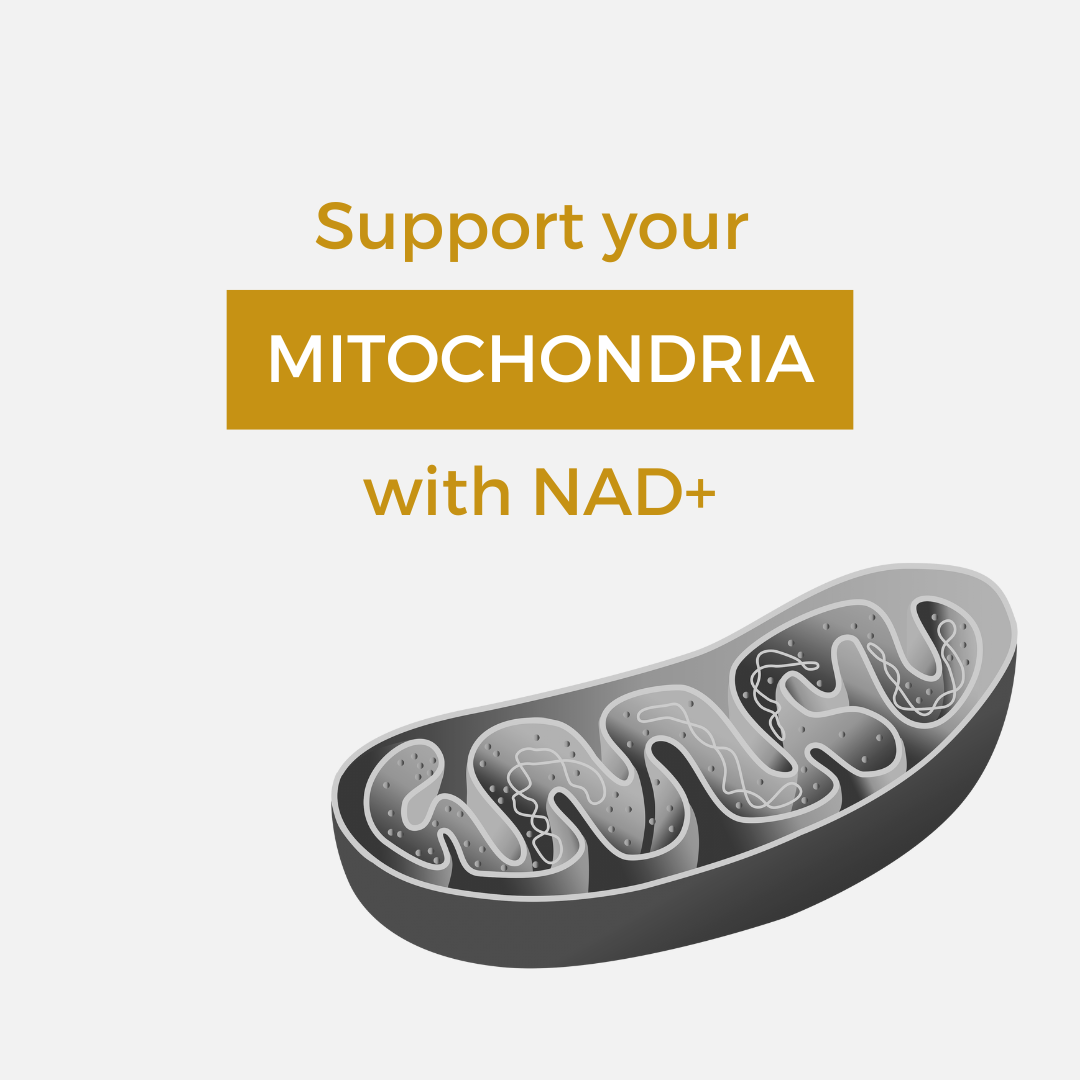
Support your mitochondria with NAD+
Mitochondria have earned a reputation as the "powerhouses of the cell" thanks to their energy-producing role, but that's only part of the picture. We now understand they're just as important for healthy aging.
Mitochondrial dysfunction is recognised as a key hallmark of aging, and the evidence suggests that the decline in mitochondrial number and function we experience over time contributes to some of the most familiar signs of getting older, including lower energy and reduced mental sharpness. This article explains why mitochondria matter so much, how they connect to the aging process, and how supporting your NAD+ levels may help support mitochondrial health.
Summary:
- Mitochondria produce the energy every cell in your body relies on to function
- Mitochondrial dysfunction is recognised as one of the key hallmarks of aging
- Mitochondrial number and function naturally decline with age, largely due to free radical damage, reduced mitophagy, and reduced biogenesis
- NAD+ and the sirtuin proteins it activates play a central role in supporting mitochondrial health
- Supporting your NAD+ levels with Nuchido TIME+ and lifestyle habits like exercise and red light therapy, can help support mitochondrial function as you age
What do mitochondria actually do?
Mitochondria produce ATP, the form of energy every cell in your body needs to function. You might think of them as tiny power stations, except each cell can contain thousands of them, working together as dynamic, adaptable networks rather than as isolated units.
This is why organs with high energy demands, like the brain and the heart, tend to have far more mitochondria than other tissues. The network can change in size, shape, and mass depending on what the cell needs at any given time.
Interestingly, mitochondria weren't always part of our cells. They're thought to have originated as separate bacteria that gradually evolved into a partnership with our cells, eventually becoming so interdependent that neither could survive without the other. This is also why mitochondria carry their own DNA (called mtDNA), separate from the DNA held in the cell's nucleus.
Why does mitochondrial function decline with age?
Mitochondrial function declines with age for a few interconnected reasons. Here's a summary of what's happening at a cellular level:
| Mechanism | What happens with age |
| Increased free radical damage | Free radicals are a natural byproduct of energy production. As antioxidant pathways decline with age, free radicals accumulate and damage mitochondrial structures. |
| Decreased mitophagy |
Mitophagy is the process that clears out damaged mitochondria. As it slows down, dysfunctional mitochondria build up, increasing free radical production and inflammation. |
| Decreased mitochondrial biogenesis |
New mitochondria are produced in response to the cell's energy demands, for example during exercise. With age, communication between the mitochondria and the nucleus weakens, so this response becomes less effective and mitochondrial numbers decline. |
Together, these changes lead to mitochondrial dysfunction, in everyday life, this might show up as changes you can actually feel. You may notice it as that mid-afternoon energy dip that never used to happen, needing longer to recover after a workout, or finding it a little harder to concentrate by the end of a long day. So what can you actually do to help support your mitochondria?
How does NAD+ support mitochondrial health?
Increasing your NAD+ levels, and in turn activating the sirtuin proteins that depend on it, is understood to help support mitochondrial health. This is because NAD+ and the sirtuins are involved in addressing several of the issues linked to mitochondrial dysfunction outlined above.
NAD+ levels are known to decline by around 50% every 20 years, and this decline is considered a driver of the cellular aging process. Since NAD+ is essential for mitochondrial energy production, its decline is closely tied to the drop in energy many of us notice as we get older. Sirtuins also depend entirely on NAD+ to function, without it, they simply can't do their job. Nuchido TIME+ has been shown in clinical trials to increase NAD+ levels and activate SIRT1, offering an evidence-backed way to support this process.
There are seven sirtuin proteins found throughout the cell, and several are directly involved in mitochondrial health. SIRT3 is based within the mitochondria itself, while SIRT1 works more broadly to coordinate the cell's response to energy demand.
Here's how they connect back to the three mechanisms behind mitochondrial decline:
| Mechanism of decline |
How NAD+ and sirtuins are understood to help |
| Increased free radical damage | NAD+-activated SIRT3 switches on antioxidant pathways within the mitochondria, supporting the body's own defence against free radical accumulation. |
| Decreased mitophagy | SIRT1 and SIRT3 help activate mitophagy via pathways like AMPK and FOXO, supporting the clearance of damaged mitochondria. |
| Decreased mitochondrial biogenesis |
SIRT1 activates PGC-1α, the master regulator of mitochondrial biogenesis, supporting the production of new mitochondria. |
Sirtuins act as messengers between the mitochondria and the nucleus. In younger cells, this communication runs smoothly, allowing mitochondria to respond well to the cell's changing needs. As sirtuin levels decline with age, that communication becomes less reliable, which is part of why mitochondrial health tends to decline alongside it.
How can you support your mitochondria day to day?
Alongside supporting your NAD+ levels, a few well-evidenced habits are understood to support mitochondrial health directly:
- Move regularly. Exercise, particularly a mix of cardiovascular and resistance training, is one of the most reliable natural triggers for mitochondrial biogenesis and mitophagy.
- Prioritise sleep. Cellular repair processes, including mitophagy, are understood to be more active during quality sleep.
- Explore red and near-infrared light therapy. Also known as photobiomodulation, this involves exposure to red and near-infrared light to stimulate mitochondrial function and cellular repair. There is a growing body of evidence to support red light therapy for skin health, inflammation and cellular energy support.
- Consider sauna use. Heat exposure activates heat shock proteins and switches on the same PGC-1α pathway involved in mitochondrial biogenesis, similar to some of the effects seen with exercise.
- Support your NAD+ levels. NAD+ decline is closely linked to reduced mitochondrial function. You can support your NAD+ levels with Nuchido TIME+, the daily supplement clinically proven to boost NAD+ and activate SIRT1.
Mitochondria are essential to almost every part of how we feel and function, from the mental sharpness we rely on to get through a busy day, to the energy in our muscles, to the visible health of our skin. When we talk about supporting mitochondrial health, we're really talking about supporting the foundation that everything else is built on.
The good news is that this isn't only in the hands of chance. Your daily habits can support healthy mitochondrial function as you age, so you can continue to feel your best.
References:
- López-Otín, C., Blasco, M. A., Partridge, L., Serrano, M., & Kroemer, G. (2013). The hallmarks of aging. Cell, 153(6), 1194-1217.
- Liu, Y. J., McIntyre, R. L., Janssens, G. E., & Houtkooper, R. H. (2020). Mitochondrial fission and fusion: A dynamic role in aging and potential target for age-related disease. Mechanisms of ageing and development, 186, 111212.
- Chen, G., Kroemer, G., & Kepp, O. (2020). Mitophagy: an emerging role in aging and age-associated diseases. Frontiers in cell and developmental biology, 8, 200.
- López-Lluch, G., Irusta, P. M., Navas, P., & de Cabo, R. (2008). Mitochondrial biogenesis and healthy aging. Experimental gerontology, 43(9), 813-819.
- Imai, S. I., & Guarente, L. (2016). It takes two to tango: NAD+ and sirtuins in aging/longevity control. npj Aging and Mechanisms of Disease, 2(1), 1-6.
- Meng, H., Yan, W. Y., Lei, Y. H., Wan, Z., Hou, Y. Y., Sun, L. K., & Zhou, J. P. (2019). SIRT3 regulation of mitochondrial quality control in neurodegenerative diseases. Frontiers in Aging Neuroscience, 11, 313.
- Zhang, J., Xiang, H., Liu, J., Chen, Y., He, R. R., & Liu, B. (2020). Mitochondrial Sirtuin 3: New emerging biological function and therapeutic target. Theranostics, 10(18), 8315.
- Wan, W., Hua, F., Fang, P., Li, C., Deng, F., Chen, S., ... & Wang, X. (2022). Regulation of Mitophagy by Sirtuin Family Proteins: A Vital Role in Aging and Age-Related Diseases. Frontiers in Aging Neuroscience, 14, 845330.
- Yuan, Y., Cruzat, V. F., Newsholme, P., Cheng, J., Chen, Y., & Lu, Y. (2016). Regulation of SIRT1 in aging: roles in mitochondrial function and biogenesis. Mechanisms of ageing and development, 155, 10-21.